
Background
From asphalt and concrete plants to pavers, mills, and the mobile equipment that moves between job sites, Astec is a global manufacturer serving the full "Rock to Road" value chain. Alongside that physical equipment, they had been growing a portfolio of digital tools: telematics boxes, plant control systems, and monitoring sensors that generated a wealth of operational data.
The catalyst for our work was a vision from Astec's VP of Innovation. He wanted to take a company built on manufacturing revenue and add something new alongside it: a SaaS business line that complemented the paving equipment and opened up recurring digital revenue streams. The obstacle was the state of the existing digital tools. Plant dashboards ran on premise and were heavily customized for each large customer, which made them powerful for a few but impossible to scale, and a missed opportunity for a real digital business. Equipment and deliveries were hard to track, the tools were fragmented across separate systems, and the underlying monitoring software and sensors were aging.
Astec brought Scenic West on as B2B SaaS Innovation Product Strategy and User Experience partner, seamlessly embedded with their internal engineering leadership and a third party development team, to bring that vision into a scalable, cloud based product.
Discovery
To lay the groundwork, our team traveled to Astec's home base in Chattanooga, Tennessee, for on-site interviews with internal experts and early discovery workshops, learning the foundations of how asphalt plants work, what the equipment does, and what the people running it actually need.
One important thing we learned was how differently users needed to work depending on where they were located at a given point in the day. Plant operators were on premise, while supervisors might be traveling across multiple sites, and leadership or operations might be in a corporate office. Any platform we designed would have to work across a variety of contexts and devices to support team members on site and on the go.
Deliveries also relied on a mistake-prone handoff process due to the inconsistency in equipment scanning, workers astonishingly relied on paper receipts given by hand, taken by word. We knew there was a more efficient way to give executives peace of mind their materials were arriving where they needed to.
From there, we ran a series of team workshops to prioritize features for the beta and MVP, define permissions and roles, and map user flows. A pivotal insight surfaced early: the existing setup was user based, but the way Astec's customers actually operate demanded a shift to more complex site, asset, and role based permissions, so access and information could be tailored to what each kind of user needs.
That shaped the personas we designed around. Alongside the research, we ran a UX audit of the existing software, pinpointing user pain points and clear opportunities to make the platform easier to use and the equipment interfaces cleaner and more legible.
Underneath it all was a clear set of goals from Astec:
- bring their connected solutions data and delivery system into one consolidated cloud platform
- give customers insight into asset health of asphalt plants, concrete plants, pavers, and mills from anywhere
- pair alerting with genuinely actionable insights
- simplify their roles and permissions schema
They wanted real time dashboards tailored to specific roles, from executives to foremen to operators, pre configured reports for plant data analysis, and custom reporting tools so customers could build their own dashboards and explorations. They also needed to equip their own service team with machine schematics, so power users of the platform could reduce the number of team on-site visits.
How We Did It
The strategic product roadmap was deliberately phased: launch first as a beta to a handful of trusted clients to collect real data and feedback, then refine and launch the MVP roughly three months later.
Because Astec was a Microsoft and Azure-based organization, we built on Fluent UI with a material layer on top, a choice that kept the new platform aligned with their technology stack while giving us the design flexibility we needed.
Our process:
- After conducting discovery workshops, we put proof of concepts in front of internal users to understand early value propositions.
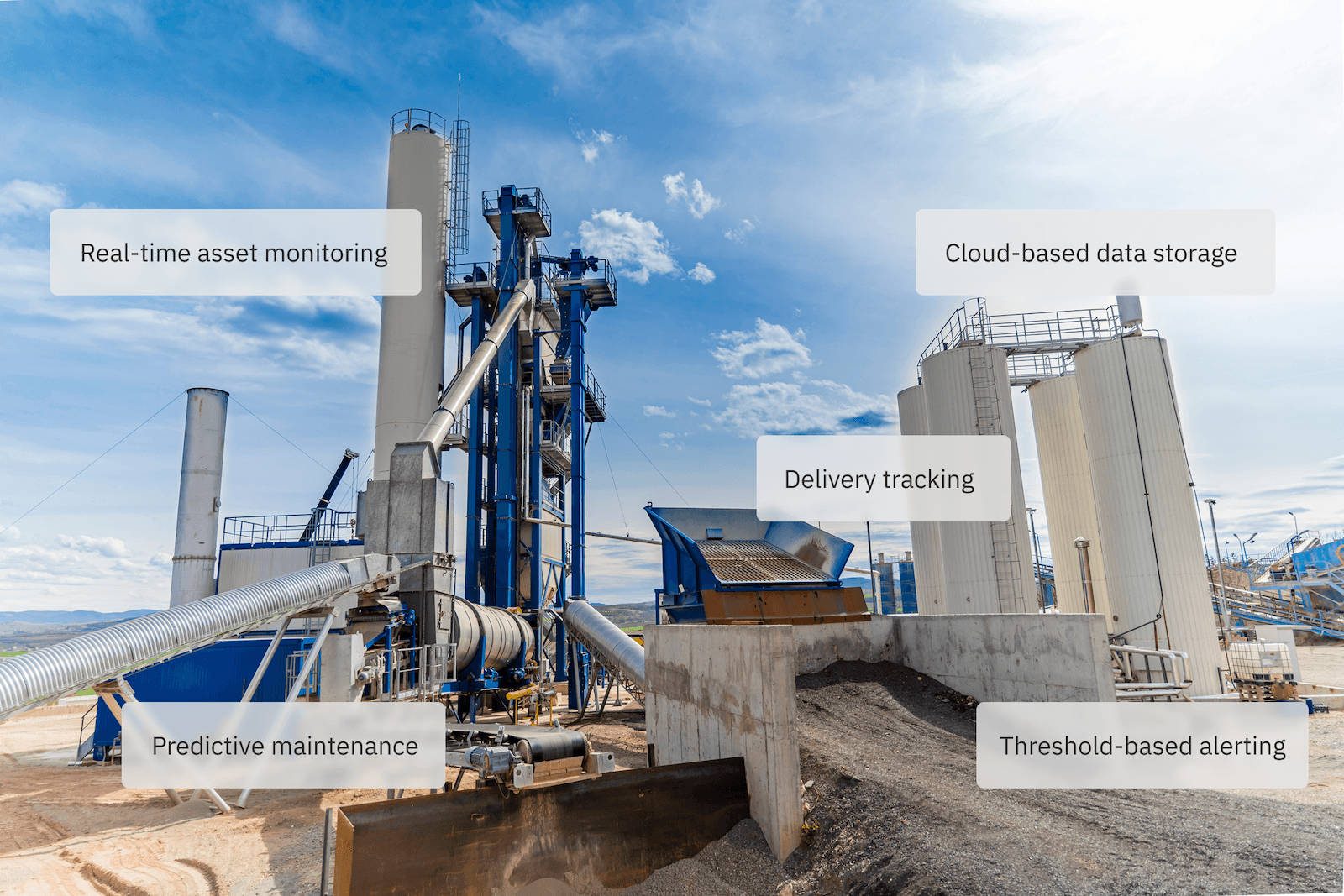
- This allowed us to focus early on what positioning was needed across plant operational insights, maintenance, threshold-based alerting, and user management feature sets unique to each site.
- The most interesting challenge was physical asset management layered with users and roles. We had to design a system that could represent complex, real-world assets at scale and then apply permission logic on top of them, so that a regional supervisor could see many plants in aggregate while a plant operator saw only the specific operational subset relevant to their work.
- Once the team aligned on the role-based permissions that would cleanly facilitate their asset management, we started with dashboards catered to each level of a site. From there, we added the views that would allow them to drill down to specific equipment or plant data.
- We refined the designs through weekly meetings with stakeholders and the development team, keeping design and build in tight sync.
- We built user feedback loops that guided beta users through the platform and gathered their insights as they went.
- Because our team was near Astec's top beta clients, we attended on-site beta account training in person, gaining rich, firsthand insights and setting those clients up for success.
- Users gave us detailed input grounded in real, day to day use. Having an established user feedback loop allowed us to easily prioritize requests as they came in. We applied what we heard for not just MVP, but future rollouts thereafter.
Impact
What began as a way to connect fragmented, on premise tools became a durable foundation for Astec's digital future. We helped move them away from bespoke, per customer dashboards that couldn't scale and toward a single, cloud based platform designed from the start for many customers and many roles. Executives could scan performance across regions, supervisors could oversee multiple plants, and operators could focus on the assets in front of them, all from the same connected system, and all from anywhere.
That groundwork outlasted the initial engagement. In early 2024, Astec formally launched its Astec Digital business unit, bringing its full portfolio of digital tools together under one roof, and our work lives on today inside the platform's Signal Connectivity Suite. Our partnership with Astec also continued beyond the first release, expanding into additional feature sets, including e-ticketing, and maintaining UX and UI standards as the product line grew through Astec's broader digital expansion.